
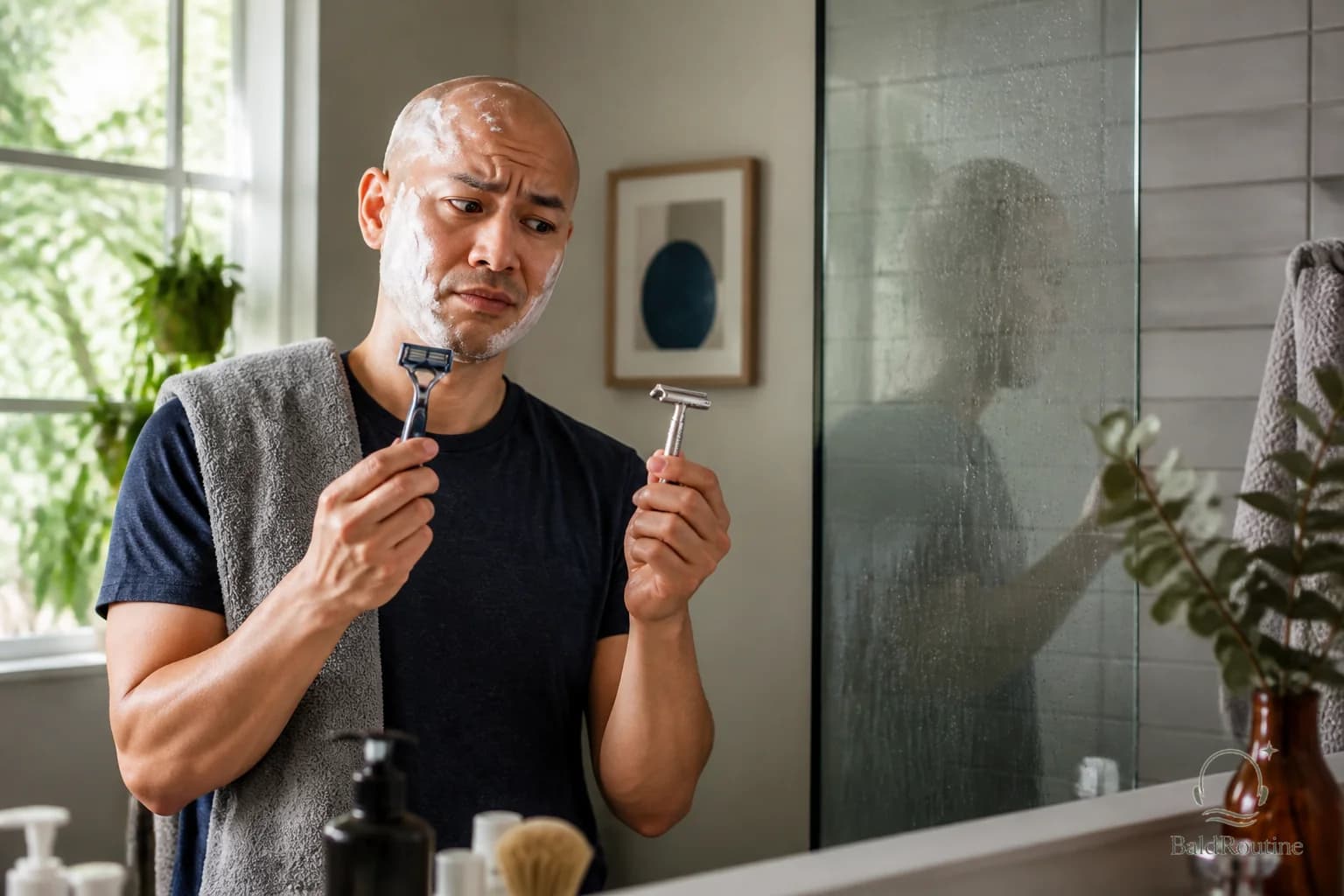
Wet shave or dry shave for a bald head
There are two kinds of bald head shaving advice online.
One side acts like a wet shave with a razor is the only serious option. The other side acts like an electric shaver solves every problem because it is fast and neat.
Both are too neat.
A bald scalp is not a flat cheek. You are shaving around curves, bumps, direction changes, and spots you cannot see well. The best choice is not the one that sounds most impressive. It is the one you can repeat without your scalp feeling tight, scraped, shiny in a bad way, or annoyed by lunch.
Wet shaving and dry shaving both work. They just ask for different tradeoffs.
What wet shaving does well
Wet shaving usually means using water, shave cream or gel, and a razor. It can be a cartridge razor or a safety razor, but the idea is the same: soften the hair, add glide, shave close, rinse.
The main appeal is smoothness. A good wet shave can leave your head feeling cleaner and closer than most dry electric shaves. If you like that freshly shaved feel and you do not mind spending a few extra minutes, wet shaving makes sense.
Wet shaving can also be easier to control in certain areas. Around the ears, neckline, and back edge of the head, a razor gives you direct feedback. You can feel where the blade is and move slowly.
The catch is that wet shaving is less forgiving when you rush. Too much pressure, repeated passes, a dull blade, or poor rinsing can make your scalp feel dry or irritated fast. A wet shave is not automatically gentler just because there is water involved.
What dry shaving does well
Dry shaving usually means using an electric shaver on a dry scalp. No sink full of foam. No blade rinsing every few strokes. No full bathroom reset.
The main appeal is consistency. If you shave often, dry shaving can be easier to keep up with because there is less setup. That matters more than people admit. A routine you can actually do beats a perfect routine you avoid.
Dry shaving can also be useful when you do not need the absolute closest result. If you are shaving daily or every other day, a dry electric shave may keep the scalp looking tidy without turning the whole process into a production.
The tradeoff is closeness. Some electric shavers leave a faint texture behind, especially if your hair is coarse or grows in multiple directions. You may also need slower overlapping passes to catch everything. Pressing harder to make an electric shaver behave like a razor is where people get into trouble.
Pick wet shaving if you care most about closeness
Wet shaving is the better fit if your priority is the smoothest possible finish.
It makes sense if:
You like a very close shave
You shave every two or three days rather than multiple times a day
You have time for prep and rinsing
You are willing to replace blades before they drag
You do not mind shaving at the sink or in the shower
The move is to keep it boring. Warm water. A slick shave product. Light pressure. Short strokes. Rinse well. Pat dry. Moisturize.
Most wet shave problems come from trying to get one more perfect pass out of your scalp. That last pass is often where the scalp starts objecting.
If stinging is your usual issue after a wet shave, this is worth reading next: 5 Things that make a bald head sting after shaving.
Pick dry shaving if you care most about convenience
Dry shaving is the better fit if your priority is keeping your head neat with less effort.
It makes sense if:
You shave daily or close to daily
You want less mess
You travel often
You hate a long sink routine
You are okay with smooth enough instead of glass smooth
The mistake is treating dry shaving like a race. Electric shavers still need slow contact and clean passes. Let the tool cut. Do not mash it into your scalp like you are sanding a table.
Dry shaving also works better when the scalp is actually dry. If you are sweaty, oily, or still damp from a shower, the shaver may tug or skip. Give your scalp a minute, then shave.
If you are trying to shave often without making your scalp feel worn out, see Daily head shaving without wrecking your scalp.
The middle ground nobody talks about enough
You do not have to choose one method forever.
A lot of bald routines work better with a split approach:
Wet shave when you want the closest finish
Dry shave for maintenance between closer shaves
Use an electric shaver when traveling
Use a razor when you have more time
Switch methods if your scalp feels overworked
That is not inconsistency. That is paying attention.
Your scalp does not care whether you are loyal to a tool. It cares about pressure, friction, frequency, and what you do after the shave.
Common mistakes with both methods
The tools are different, but the mistakes repeat.
First, people chase smoothness too hard. A bald head does not need punishment to look clean. If you already shaved an area well, stop revisiting it.
Second, people ignore prep. Wet shaving needs enough water and glide. Dry shaving needs a clean, dry surface. Skipping the basics makes both methods worse.
Third, people use dirty or tired tools. A dull blade drags. A clogged electric shaver pulls and misses spots. Neither one is a badge of honor.
Fourth, people skip the finish. After shaving, rinse or wipe away residue, dry gently, then use a light moisturizer if your scalp tends to feel tight. If you are going outside, sunscreen belongs in the routine too.
Simple checklist
Use this to choose without turning your bathroom into a testing lab.
Want the closest shave? Start with wet shaving.
Want the fastest repeatable routine? Start with dry shaving.
Shaving daily? Consider dry shaving or very light wet shaves.
Shaving every few days? Wet shaving may feel cleaner.
Getting tightness or sting? Reduce pressure and passes first.
Getting missed patches? Slow down and change direction carefully.
Traveling often? Dry shaving is usually easier to maintain.
Going outside after shaving? Finish with moisturizer and sunscreen.
Bottom line
Wet shaving is usually closer. Dry shaving is usually easier to repeat.
Neither one is automatically better for every bald head. The better choice is the one that gives you a clean result without making your scalp feel like it lost an argument.
Start with your actual priority: closeness or convenience. Then build the routine around that instead of buying tools because someone online made shaving sound like a personality test.
For a simple bald scalp routine without the clutter, visit BaldRoutine.
Interest list
Want a product checklist?
Save a simple bald scalp care checklist and occasional practical tips. No routine is locked behind email.
Keep reading
Related guide
The washing mistake that keeps your bald scalp dry
If your shaved head feels dry right after you clean it you may be scrubbing off more than stubble. A simple wash routine can keep your scalp comfortable without adding five bottles to the shelf.
Related guide
Stop adding products to a dry bald scalp
If your bald scalp feels dry after shaving, another bottle is not always the fix. Start with rinse, pressure, timing, and one boring moisturizer.
Related guide
Flaky bald scalp after shaving? try this simpler routine
A flaky bald scalp after shaving does not automatically mean you need a shelf full of scalp products. Start with a calmer shave, a better rinse, and moisturizer at the right time.