
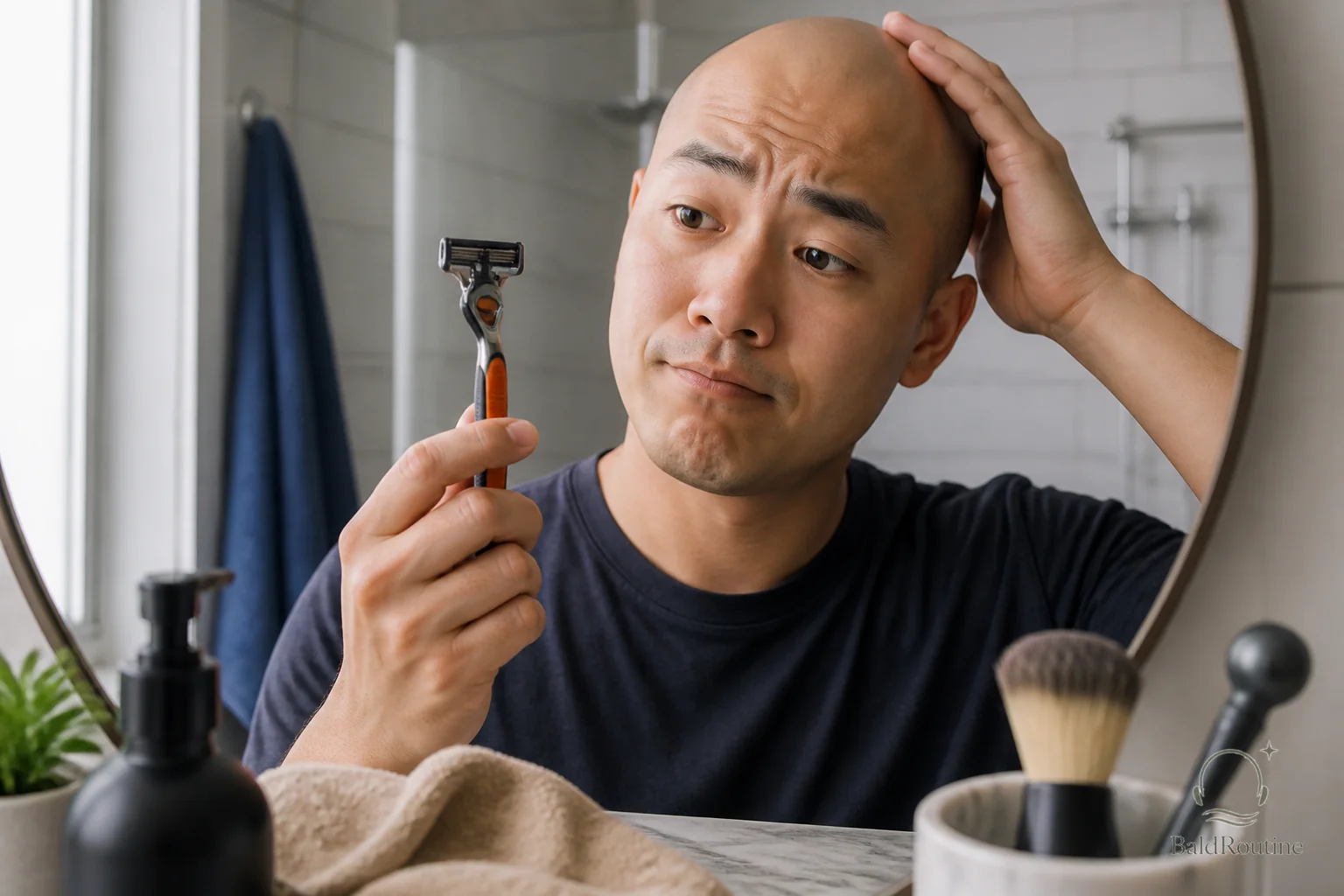
The razor handle mistake that makes head shaving harder
Most men blame the blade when a head shave feels awkward.
Sometimes they are right. A dull blade, a clogged cartridge, or too much pressure can make a shaved head feel rough fast. But there is another boring little detail that causes a lot of bad shaves: the handle.
Not the brand. Not the marketing. The actual shape of the thing in your hand.
If the handle is too slick, too short, too heavy, too light, or awkward to control behind your head, you end up pressing harder, repeating passes, missing spots, and turning a simple shave into a bathroom negotiation.
The blade gets the attention. The handle does the steering.
Why the handle matters more on a bald head
Shaving your face is mostly done where you can see what is happening. Shaving your head is different.
You are working across curves, angles, crown growth, and the back of your head. Some areas are shaved by sight. Some are shaved by feel. That means control matters more than people admit.
A good razor handle for shaving your head should make three things easier:
Keeping light pressure
Holding a steady angle
Moving around curved areas without panic grips
When the handle fights those three jobs, your routine gets sloppy. You may not notice it as a handle problem. You just notice the shave takes too long, feels uneven, or leaves your scalp annoyed afterward.
That is how people end up buying more blades, more creams, and more gadgets when the basic problem is that the tool does not fit the job.
The mistake: choosing a handle like you only shave your face
A lot of razors are built and marketed around face shaving. That does not make them bad. It just means the handle may not be ideal for a full head shave.
Face shaving usually involves shorter strokes, smaller zones, and more direct visibility. Head shaving asks more from your hand. You need to reach the back of the scalp, keep control around the ears, and avoid overworking the same area because you are not sure if you already covered it.
The mistake is buying whatever razor feels premium in the hand for five seconds at the store, then expecting it to behave well on a wet scalp.
Pretty handles do not always shave better. Chrome can look great and turn into a slippery little mistake once your hands are wet.
What to look for in a head shaving handle
You do not need a luxury razor handle. You need one that behaves predictably.
Grip that still works when wet
A smooth handle can feel fine dry and useless once shaving cream, gel, or water gets involved. Look for texture, grooves, rubberized grip, or a shape that gives your fingers somewhere to sit.
If you have to squeeze the handle hard to control it, that is already a warning sign. A death grip usually leads to extra pressure, and extra pressure is where a lot of bad head shaves begin.
Enough length to reach without twisting your wrist
A very short handle can feel precise on the face, but awkward on the back of the head. If you are constantly bending your wrist or changing your grip just to reach the crown or lower back of the scalp, the handle may be making the shave harder than it needs to be.
Longer is not automatically better. Too long can feel clumsy around the ears. The sweet spot is a handle that lets you reach the back of your head while still controlling short strokes.
Weight that does not encourage pressure
Some heavy handles feel nice because they seem solid. The tradeoff is that weight can make it easier to press without realizing it, especially when shaving tired or rushing.
Very light handles have their own problem. They can feel twitchy, cheap, or hard to guide evenly.
You want enough weight to feel stable, but not so much that the razor starts doing the pushing for you.
A shape that helps orientation
When shaving by feel, you need to know where the blade is pointing. Round slippery handles can rotate in your fingers. That is not ideal when you are shaving an area you cannot see.
A handle with subtle flat sides, grip zones, or a clear front and back can help you keep the blade angle consistent.
This is not glamorous. It is just easier.
Do not confuse handle quality with razor type
Cartridge razors, safety razors, and electric tools all have their own tradeoffs. The handle question sits inside that bigger choice.
A cartridge razor with a decent grip may be easier for a beginner than a heavier safety razor that demands more angle control. A safety razor can work well for some experienced head shavers, but the handle and technique matter a lot. If you are still deciding between formats, read Cartridge razor vs safety razor for a bald head.
Electric head shavers are a different category again. They reduce some blade angle issues, but grip and control still matter, especially around the ears and neckline. The broader point is the same: the tool should make the routine simpler, not turn your scalp into a test track.
Common handle mistakes
The first mistake is choosing the slickest handle because it looks clean on the counter. Your scalp does not care how good the razor looks next to the sink.
The second mistake is assuming expensive means easier. A pricey handle can still be wrong for your hand, your routine, and your head shape.
The third mistake is using the same grip everywhere. The top of the head, sides, crown, and back all need slightly different hand positions. If the handle only feels good in one grip, it may be limiting you.
The fourth mistake is ignoring missed spots. If you keep missing the same patch behind the ear or around the crown, it may not be your memory. It may be reach, grip, or poor control. For a quick coverage check, see 5 Missed spots that make a shaved head look uneven.
A simple handle check before you buy another razor
Before replacing your whole setup, do this quick check with your current razor.
Hold it with wet hands before shaving
See if it rotates or slips when your grip is relaxed
Practice reaching the crown and back of your head without a blade loaded if possible
Notice whether you need to press hard to feel in control
Check if the handle works in more than one grip
Pay attention to missed spots that happen in the same places
Notice whether the handle feels stable around the ears
If the handle fails most of that list, the blade may not be the main issue.
Simple checklist for choosing a better head shaving handle
Look for:
A non slick grip
Comfortable control with wet hands
Enough length for the back of the head
Stable weight without encouraging pressure
A shape that does not spin in your fingers
Easy control around ears and neckline
A design that supports short gentle strokes
Skip:
Handles that feel like wet soap
Heavy handles that make you press harder
Tiny handles that force wrist gymnastics
Fancy designs that are awkward behind your head
Anything you only like because it looks expensive
The bottom line
A better head shave does not always start with a sharper blade or a new gadget. Sometimes it starts with the part of the razor nobody wants to talk about because it sounds too simple.
The handle matters.
If it gives you control, you can use lighter pressure, cleaner strokes, and fewer repeat passes. If it fights your hand, every other part of the routine has to compensate.
That is a bad trade.
Build a routine around tools that make shaving easier, not around tools that look impressive in a drawer. For a simple bald scalp routine without the bathroom clutter, visit BaldRoutine.
Interest list
Want a product checklist?
Save a simple bald scalp care checklist and occasional practical tips. No routine is locked behind email.
Keep reading
Related guide
Stop adding products to a dry bald scalp
If your bald scalp feels dry after shaving, another bottle is not always the fix. Start with rinse, pressure, timing, and one boring moisturizer.
Related guide
Flaky bald scalp after shaving? try this simpler routine
A flaky bald scalp after shaving does not automatically mean you need a shelf full of scalp products. Start with a calmer shave, a better rinse, and moisturizer at the right time.
Related guide
Stop waiting until your bald scalp feels dry to moisturize
If your bald scalp feels fine after shaving but dry later, your timing may be the problem. A simple moisture step works better before your scalp feels tight.