
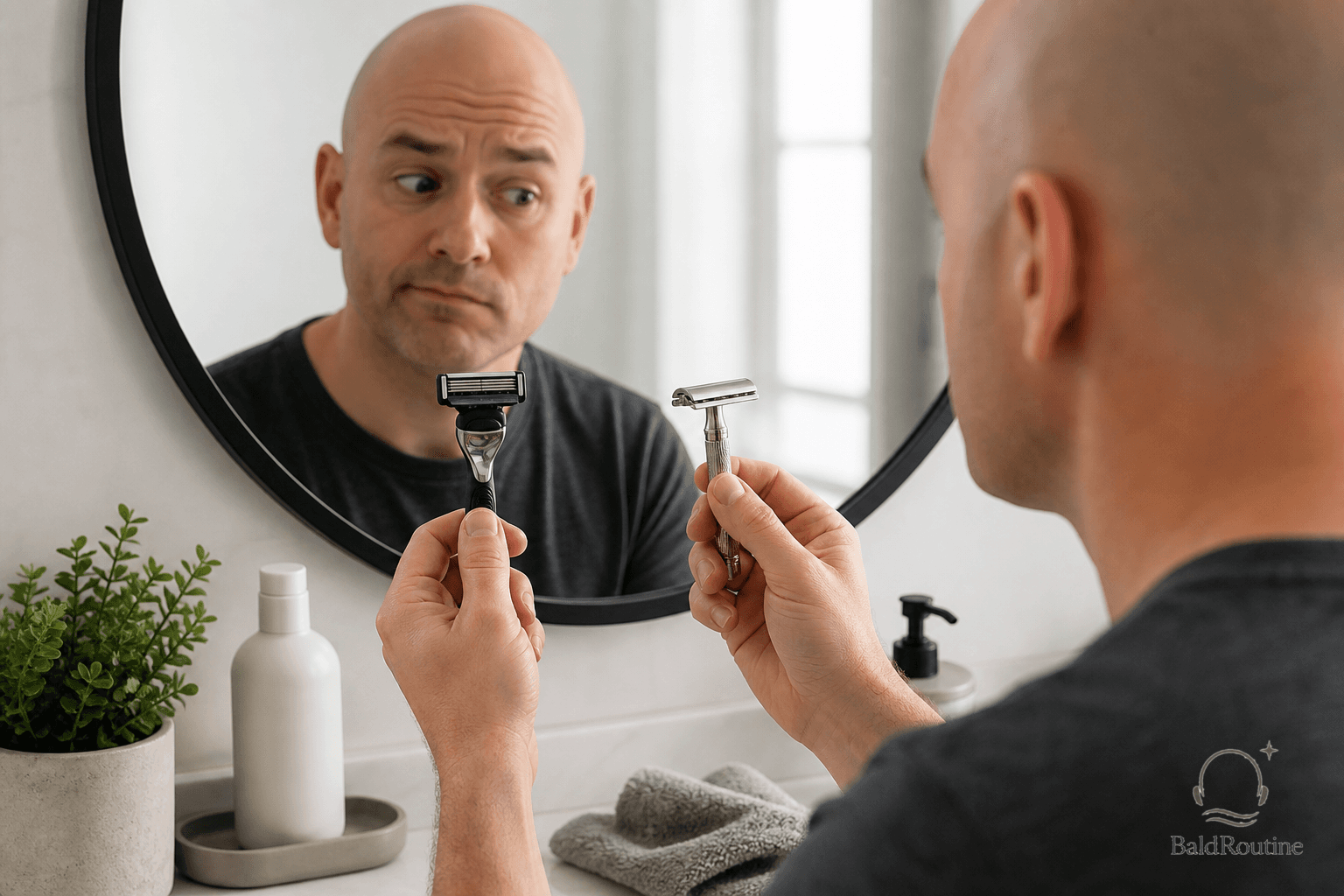
Cartridge razor vs safety razor for a bald head
Choosing a razor for your face is one thing. Choosing one for your whole scalp is different.
A bald head has curves, blind spots, thin-feeling areas, thicker-feeling areas, and a lot more surface area than your jawline. That changes the math. A razor that feels fine on your cheeks can feel grabby, harsh, or awkward once you are shaving the back of your head half by memory.
The cartridge razor vs safety razor debate gets weirdly religious online. One side says cartridges are lazy and overpriced. The other side says safety razors are a blood donation with a handle. Both are exaggerating.
The better choice is the one that matches your routine, your hand, and your tolerance for learning.
The basic difference
A cartridge razor usually has multiple blades in a pivoting head. It is built to be easy, fast, and forgiving. The head flexes around curves, which helps when you are shaving areas you cannot see well.
A safety razor usually has one exposed double edge blade held in a fixed metal head. It does not pivot for you. You control the angle, pressure, and direction. That can give you a clean, simple shave, but it also gives you fewer excuses if your technique is sloppy.
That is the tradeoff.
A cartridge razor hides some mistakes. A safety razor reveals them.
When a cartridge razor makes more sense
A cartridge razor is usually the easier choice if you are new to shaving your head or you shave in a hurry before work.
It can be a good fit if:
You are still learning the shape of your scalp
You shave mostly by feel
You want a fast routine
You tend to press too hard without noticing
You get nervous around the crown or back of the head
You want fewer technique variables to think about
The pivoting head is the big advantage. Your scalp is not flat. The back of your head, around the ears, and the lower neckline all change angle quickly. A cartridge head can follow those curves without you constantly adjusting your wrist.
The downside is that multiple blades can make it easy to overdo the same area. If you keep buffing over one patch because it still feels slightly rough, you may end up with a scalp that feels hot, tight, or annoyed afterward.
A cartridge razor is forgiving, not foolproof. There is a difference.
When a safety razor makes more sense
A safety razor can work well if you like a slower routine and you are willing to pay attention.
It can be a good fit if:
You already know your shaving grain
You use light pressure naturally
You do not rush the back of your head
You want fewer blades touching your scalp
You are comfortable learning blade angle
You prefer a more deliberate shave
The appeal is control. One blade, one pass at a time, no plastic head trying to make decisions for you. That can feel cleaner and simpler once your technique is solid.
The catch is that your technique needs to be solid.
A safety razor does not reward speed. It wants short strokes, a steady angle, and almost no pressure. If you attack your scalp like you are scraping paint off a window, your head will let you know.
If you are still figuring out direction of growth, start there before blaming the razor. Bald head shaving gets easier when you understand your grain. This guide helps: A smoother bald head shave starts with knowing your grain.
The pressure problem nobody wants to admit
Most bad head shaves are not really blade problems. They are pressure problems wearing a blade costume.
Cartridge razors can encourage pressure because they feel cushioned. Safety razors punish pressure because the blade is less forgiving. Different tool, same bad habit.
For a bald head, pressure should be light enough that the razor is doing the cutting, not your hand doing the forcing. If you need to mash the razor down to get a close shave, something else is probably off:
The blade is dull
The scalp is not prepped well
You are shaving against the grain too early
You are taking long strokes over curved areas
You are shaving the same spot too many times
A sharp blade with light pressure usually beats a fancy handle with heavy pressure.
If your current blade feels rough, drags, or makes you keep repeating passes, check this before buying another razor style: 5 signs your head shaving blade needs replacing.
Which one is better for irritation
Neither razor automatically prevents irritation.
A cartridge razor may bother some people because multiple blades pass over the same skin in one stroke. It can also clog if you use too much product or do not rinse it well.
A safety razor may bother some people because the angle is less forgiving. One bad pass with too much pressure can feel worse than several careful cartridge passes.
So the better irritation choice is not universal. It depends on the mistake you are most likely to make.
If you rush, press hard, and shave by instinct, a cartridge razor may be safer while you clean up your technique.
If you are patient, use short strokes, and can resist chasing perfect smoothness, a safety razor can be a solid option.
The annoying but useful answer is that technique beats razor identity.
A simple way to test both
Do not switch tools and change your entire routine on the same day. That makes it impossible to know what helped.
Try this instead:
Keep your shave cream or gel the same.
Shave after a warm rinse or shower.
Use the same mirror setup.
Shave with the grain first.
Use short strokes.
Rinse the razor often.
Stop chasing every tiny rough patch.
Moisturize afterward.
Compare how your scalp feels later that day, not just right after the shave.
Right after shaving, almost anything can feel smooth. The better test is what your scalp feels like by afternoon. Comfortable beats glassy for five minutes and irritated for six hours.
Common mistakes with cartridge razors
The biggest cartridge mistake is treating the pivoting head like permission to stop paying attention.
Watch for these:
Pressing harder because the razor feels cushioned
Using the same cartridge too long
Shaving too fast around the crown
Letting cream and hair clog the blades
Repeating passes over the same spot without adding more glide
Cartridge razors are convenient. Convenience is not a substitute for a light hand.
Common mistakes with safety razors
The biggest safety razor mistake is assuming a heavier handle means you need a heavier hand.
You usually need the opposite.
Watch for these:
Holding the blade at too steep of an angle
Using long strokes over curved areas
Starting against the grain too soon
Shaving the back of the head while distracted
Trying a super aggressive blade before your technique is ready
A safety razor can be calm and simple. It can also be unforgiving if you turn shaving into a speed run.
Simple checklist before you choose
Use this before buying another razor you may not need:
If you are new to shaving your head, start with a cartridge razor.
If you already have steady technique, consider a safety razor.
If you press hard, fix that before switching tools.
If you shave in a hurry, avoid tools that demand perfect angle control.
If your blade drags, replace it before blaming the razor type.
If your scalp feels irritated often, reduce passes before adding products.
If you shave mostly by feel, choose the tool you can control safely on the back of your head.
If you want the closest shave possible, accept that closer can also mean less forgiving.
So which razor should you use
For most beginners, a cartridge razor is the easier starting point for a bald head. It is faster, more familiar, and better at handling curves while you learn your scalp.
For men who already have a steady routine, a safety razor can be a clean, low clutter option. It asks for more attention, but it gives you more control.
Do not pick the razor that sounds coolest online. Pick the one that lets you shave with light pressure, fewer repeat passes, and less drama afterward.
That is the routine worth keeping.
If you want a simple bald head routine without turning your bathroom into a product testing lab, start here: BaldRoutine.
Interest list
Want a product checklist?
Save a simple bald scalp care checklist and occasional practical tips. No routine is locked behind email.
Keep reading
Related guide
Stop adding products to a dry bald scalp
If your bald scalp feels dry after shaving, another bottle is not always the fix. Start with rinse, pressure, timing, and one boring moisturizer.
Related guide
Flaky bald scalp after shaving? try this simpler routine
A flaky bald scalp after shaving does not automatically mean you need a shelf full of scalp products. Start with a calmer shave, a better rinse, and moisturizer at the right time.
Related guide
Stop waiting until your bald scalp feels dry to moisturize
If your bald scalp feels fine after shaving but dry later, your timing may be the problem. A simple moisture step works better before your scalp feels tight.