
5 Signs your head shaving tools need replacing
A bald head routine does not need a drawer full of gear. Most guys do not need five razors, three aftershaves, a special polishing cloth, and a travel case that looks like it belongs to a camera crew.
But the tools you do use have to be in decent shape.
A worn blade, tired electric shaver, slippery handle, or bad mirror can make you press harder, shave the same spot too many times, and finish with a scalp that feels more annoyed than clean. Then it is easy to blame your skin, your technique, or the fact that you shave your head at all.
Sometimes the problem is simpler: your tools are cooked.
Here are five signs your head shaving tools need replacing before you buy anything more complicated.
1. Your razor tugs instead of gliding
A good head shave should not feel like you are negotiating with the blade.
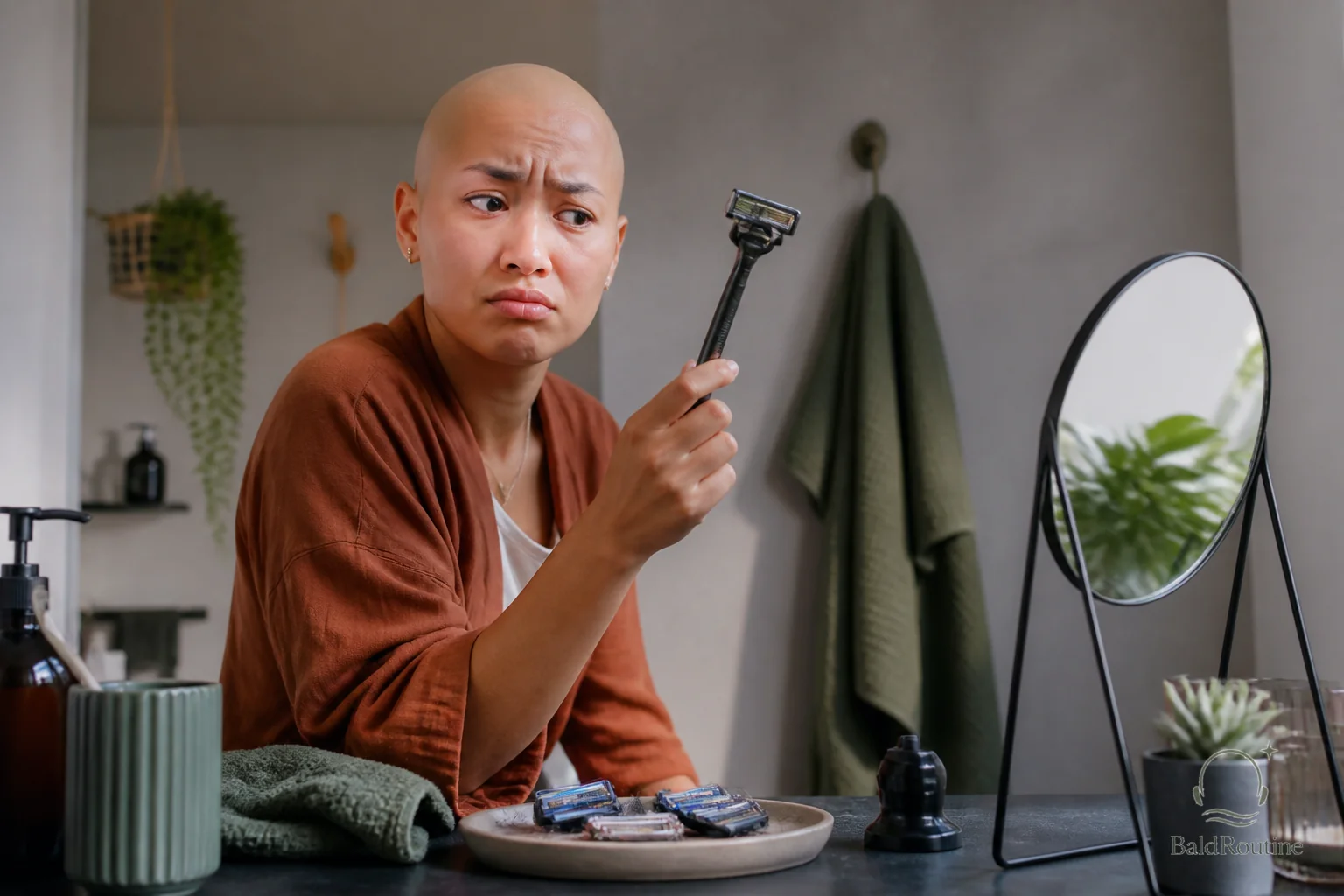
If your razor starts tugging, skipping, or catching on short hair, that is usually a sign the blade is dull, clogged, damaged, or past its useful life. This can happen with cartridge razors, safety razor blades, and disposable razors.
The scalp has curves, especially around the crown, temples, and back of the head. A dull blade makes those areas harder because it does not cut cleanly on the first pass. So you compensate by pressing harder or going over the same area again and again.
That is where a lot of unnecessary roughness starts.
A simple rule: if the razor felt fine last week and now every pass takes more effort, replace the blade before changing the whole routine.
If you want a deeper reset on this, read A better bald head shave starts with a clean razor.
2. Your electric shaver takes twice as long
Electric head shavers are convenient, but they are not magic. The heads, cutters, foils, and guards wear down. Hair and skin debris build up. Batteries get weaker. The result is usually not dramatic at first. It just starts taking longer.
You run the shaver over the same patch again. Then again. Then you start adding pressure because the tool is not doing its job. That defeats the whole point of using an electric shaver for an easier, lower mess shave.
Look for these signs:
It needs more passes than usual
It leaves random rough patches
It feels hotter during use
It sounds weaker or strained
The shave is uneven even when you take your time
Check the manufacturer guidance for replacing heads or cutters. You do not need to obsess over the exact day, but ignoring worn parts for months usually turns convenience into friction.
If you are still deciding what belongs in your routine, Electric shaver vs razor for a bald head shave breaks down the tradeoff without pretending one tool wins for everyone.
3. Your shaving cream or gel stops giving you slip
This one gets missed because it is not technically a tool. But for a shaved head, your shave product is part of the tool system.
If your cream, gel, or shave butter dries too fast, feels sticky, or does not give the razor enough glide, your blade has to work harder. That usually means more drag across the scalp.
You do not need a luxury product. You do need something that stays slick long enough to shave the full surface of your head without rushing.
Replace or rethink your shave product if:
It disappears before you finish a section
It feels pasty instead of slick
You keep rewetting it just to make it usable
Your razor clogs constantly
Your scalp feels scraped even with a fresh blade
Also check how much you are using. Too little product makes the shave dry. Too much thick product can clog the razor and hide missed spots. Annoying, but fixable.
4. Your mirror setup makes you guess
A bad mirror does not scrape your scalp directly, but it still causes bad shaves.
If you cannot clearly see the back of your head, the crown, or the area behind your ears, you end up shaving by hope. Hope is not a routine. It is how you miss patches, overwork easy spots, and nick awkward angles.
You may not need a fancy mirror system. But if your current setup forces you to twist, squint, or use your phone camera like a security feed, it might be time to upgrade the basics.
Good enough usually means:
Bright lighting from the front or above
A mirror you can use without hunching
A second mirror or hand mirror for the back
Enough visibility to check the crown
No fogged glass during the actual shave
This is especially useful if you shave with a razor. Electric shavers are more forgiving, but even then, poor visibility makes it easier to miss spots and chase uneven texture later.
5. Your routine depends on pressure
This is the biggest warning sign.
If your shave only works when you press hard, something in the setup is off. It could be the blade. It could be the electric shaver head. It could be poor prep, weak shave product, bad lighting, or shaving hair that is a little too long for the tool you are using.
Pressure should not be the main strategy.
A bald head has curves and tight angles. More force does not make those easier. It usually just makes the shave feel harsher and less predictable.
Before buying a new gadget, run through the boring checks:
Is the blade fresh?
Is the razor rinsing cleanly?
Is the shaver head clean and not worn out?
Is your shave product still slick?
Can you actually see what you are shaving?
Are you trying to shave too fast?
If one of those is off, fix that first. A better tool only helps if the simple stuff is not already working against you.
Common replacement mistakes
The most common mistake is replacing the wrong thing.
A guy gets a rough shave and immediately buys a new razor handle, when the issue was a dull cartridge. Or he switches to an electric shaver, when the real problem was shaving dry with bad prep. Or he buys a whole kit when all he needed was better lighting and a clean blade.
The second mistake is keeping old tools around because they technically still work. A razor that still cuts is not the same as a razor that cuts comfortably. An electric shaver that still turns on is not the same as one that gives you an even shave without extra passes.
The third mistake is chasing closeness at any cost. A smooth finish is nice. A scalp that feels beat up for the next six hours is a bad trade.
Simple head shaving tool checklist
Use this before your next shave:
Replace the blade if it tugs, skips, or needs pressure
Clean the razor or shaver before judging the tool
Check electric shaver heads, foils, and cutters for wear
Use a shave product that stays slick until you finish
Improve lighting before blaming your technique
Use a second mirror if the back of your head is guesswork
Stop adding pressure to make a tired tool perform
Replace boring essentials before buying new gadgets
Keep the routine boring on purpose
The best head shaving setup is usually not the most expensive one. It is the one you can repeat without friction.
Fresh cutting surfaces. Enough slip. Clean tools. Decent visibility. Light pressure. That is the core of it.
If your routine has started feeling harder than it used to, do not assume your scalp suddenly became difficult. Check the tools first. They might be doing a quiet, terrible job.
Want a simpler bald head routine without turning your bathroom into a grooming aisle? Start with BaldRoutine.
Interest list
Want a product checklist?
Save a simple bald scalp care checklist and occasional practical tips. No routine is locked behind email.
Keep reading
Related guide
Stop adding products to a dry bald scalp
If your bald scalp feels dry after shaving, another bottle is not always the fix. Start with rinse, pressure, timing, and one boring moisturizer.
Related guide
Flaky bald scalp after shaving? try this simpler routine
A flaky bald scalp after shaving does not automatically mean you need a shelf full of scalp products. Start with a calmer shave, a better rinse, and moisturizer at the right time.
Related guide
Stop waiting until your bald scalp feels dry to moisturize
If your bald scalp feels fine after shaving but dry later, your timing may be the problem. A simple moisture step works better before your scalp feels tight.